Several key factors make vinyl railing a clear choice for today’s homeowners.
MAINTENANCE
Perhaps the biggest difference between wood and vinyl railing is the amount of maintenance each requires. Wood railing requires considerably more upkeep, not only to keep the railing looking good but to increase the longevity of the product. Wood railing requires regular painting, staining or sealing to keep its appearance and to protect the wood from rotting, warping and insects. This upkeep means a considerable investment of time and money.
It is commonly recommended for wood railing to be stained or sealed every two to three years depending upon the type of wood used and railing’s exposure to the elements.
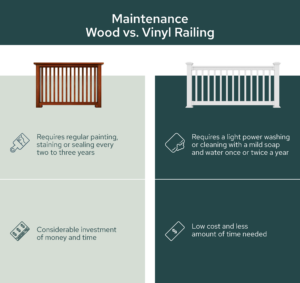
On the other hand, vinyl railing is low maintenance, requiring a light power washing or cleaning with a mild soap and water once or twice a year to remove any built-up dirt or debris. Besides being easy to clean, vinyl railing never requires painting, staining or sealing meaning in the long run you’ll spend less time and money on maintenance.
ENVIRONMENTAL EXPOSURE
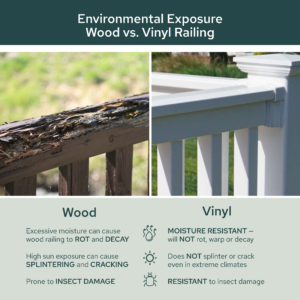
In regions with a high amount of rainfall or moisture wood railing tends to swell — breaking down the wood fibers from the inside which can lead to rot and decay and weakens the overall stability of the railing. High sun exposure may also lead to cracking and splintering and can cause wood to appear dull, grayish and weathered. Vinyl railing is manufactured to stand up to the elements. Made from durable PVC (polyvinyl chloride) — it will not rot, warp, splinter or crack. Vinyl is also impervious to damage from insects which can also factor into costly repairs and replacement if an infestation breaks out within wood railing.
COST
While the initial investment to purchase vinyl railing may be slightly higher than wood, in the long run homeowners will find they will save not only in maintenance costs but also in replacement. Given they are made a natural material, wood railings tend to have a shorter lifespan than vinyl — especially if the wood is not maintained properly or is in an area with extreme climate exposure.
Repairing a wood railing also carries a significant price tag. As wood railings age, more frequent repairs are generally required — anything from replacing rusted nails to rotted boards and balusters.
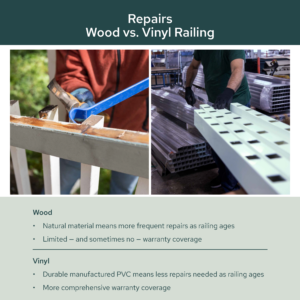
Wood railing also tends to offer limited — and sometimes no — warranties. Since warranties are designed to cover defects in manufactured products and not natural materials, homeowners will find more comprehensive and extensive warranties for vinyl railing. Some manufacturers, like Barrette Outdoor Living who produces RDI Railing, offer an industry-leading Transferable Limited Lifetime Warranty, giving homeowners peace of mind for decades.
STYLE
Advances in vinyl railing have allowed for options not just in terms of color but also in terms of top rail styles and balusters/infills.
From traditional “T-Top top rails to adapters that allow a deck board to be used as a flat “cocktail rail” allowing for the installation of a deck board that can match or complement a homeowner’s deck or porch, vinyl railing tends to allow for greater customization than wood railing. For example, RDI Railing’s Finyl LineTM Vinyl Railing offers two top rail options, two color choices (White or Clay) and three baluster/infill styles (Round Aluminum, Square Vinyl or Turned Vinyl).
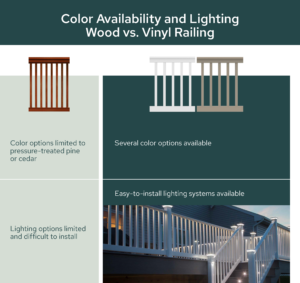
Vinyl railing not only offers a wider range of top rail options, it also offers more colors than wood which can be limited to pressure-treated pine or cedar. And with infill options ranging from traditional square or turned balusters to more modern cable or glass, vinyl railing also offers a wide range of styles for greater customization.
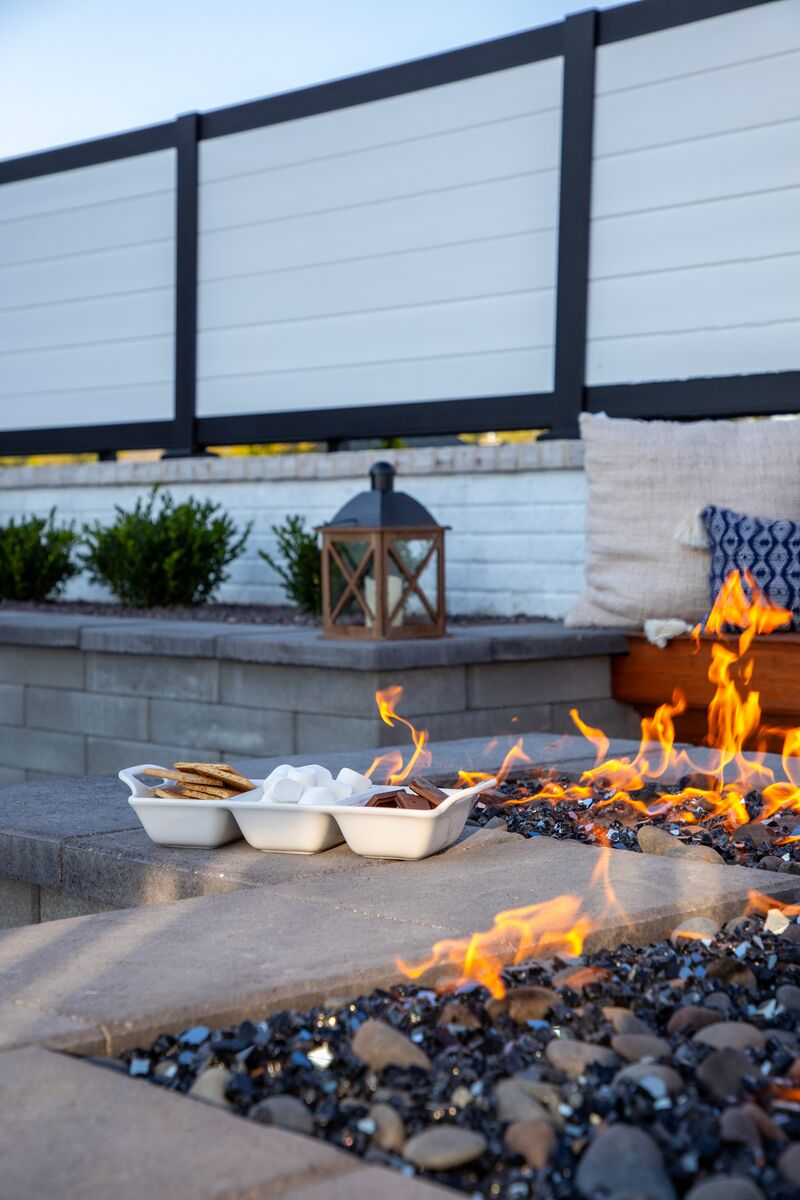
Finyl Line also features a unique style on the market today — the option to use Decorative Screen Panels as infills. You can even alternate panels with more traditional infills to create a stunning — and totally unique — combination.
For a more modern style, Finyl Line also offers black round aluminum balusters protected by a premium powder coat to create a mixed material railing.
LIGHTING
Many vinyl railings also allow for the addition of LED lighting — through under-rail lights, LED post caps, stair lights and other lighting components. Lighting not only adds ambience to your outdoor space, it also provides additional safety for areas that are frequently used in the evening.
With vinyl railing, under-rail LED light strips tend to be on an adhesive back and can be easily installed on the underside of the top rail. Wiring for LED post caps can also be run through vinyl posts or concealed inside vinyl sleeves that cover wooden posts — allowing for a clean installation and integrated aesthetic.
With wood railing, lighting strips are more difficult to install — needing to either be stapled or tacked underneath the top rail. Adhesive strip lighting usually won’t stick to wood the same as it will with vinyl so may limit what type of lighting products can be used. And depending upon exposure to the elements, staples or tacks can rust quickly and look less professional.
DURABILITY AND EASE OF HANDLING
Durability is also a huge difference between wood and vinyl railings. No matter the amount of upkeep, wood railing and posts will naturally break down as the wood fibers begin to deteriorate. This breakdown can cause bending and sagging in railing panels which can become a safety issue if not properly addressed. By reinforcing its top and bottom rails with aluminum for added strength, RDI Railing’s Endurance® Original RailTM Vinyl Railing is designed to be as durable as it is attractive.
RDI Railing’s Titan Pro Rail® Vinyl Railing features steel posts that are clad in low-maintenance vinyl to provide superior strength and support — making it an ideal choice for both residential and commercial applications.
Most vinyl railing systems also have brackets that conceal all fasteners to provide a clean, finished look compared to wood railings where screws are often visible and left exposed to the elements increasing the chance for rust and rot.
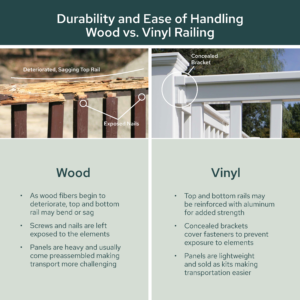
Transportation and storage of vinyl railing tends to be easier for contractors and DIY homeowners since most vinyl railings are sold in kits. Wood railing usually comes in preassembled panels and are not only more difficult to transport, but heavier to carry and harder to store until you are ready to begin installation.
CODE COMPLIANCY
Whatever railing you choose, ensuring it meets code compliancy is essential. Large railing brands, like RDI Railing, manufacture their vinyl railing in plants that also have in-house testing facilities. This means dedicated staff are in place to routinely check for quality and safety issues as well as conduct specific testing to ensure all products meet code compliancy.