


Frequently Asked Questions
Sort By
Search
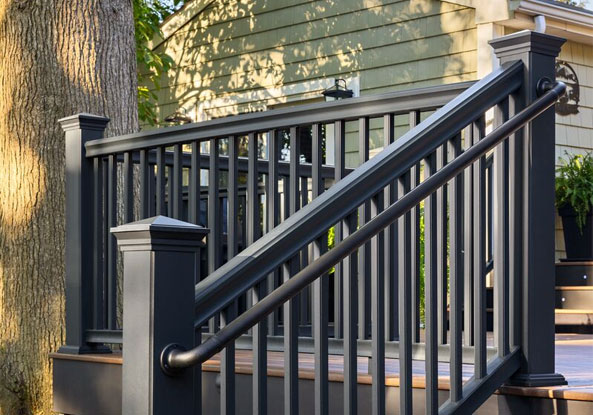
Can I use RDI® Avalon® Aluminum Railing on a second story?
Yes, Avalon Aluminum Railing® meets or exceeds all code requirements. It is important to always check with your local code enforcement office for the requirements on your project.
What type of saw can I cut RDI® Avalon® Aluminum Railing with?
Avalon Aluminum Railing® can be cut with most saw types. When using a power miter saw, a high tooth count (80 or more) carbide tip is best. Be sure to have the blade up to speed before beginning your cut. Hacksaws and other saws with metal cutting blades will also cut aluminum railing.
Do you have load-bearing posts for RDI® Aluminum Railing?
Yes, you can use the 4 1/4″ x 4 1/4″ x 108″ columns with mounting kits for both the top and the bottom of the column.
How do I manage the posts at the top of the stairs for RDI® Avalon® Aluminum Railing with Cable?
Double post at the top of the stairs. Stair posts were engineered so that the cable would not hit the nose of the stairs and also prevent a 6” sphere violation.
What limitations are there with corner installations for RDI® Avalon® Aluminum Railing with Cable?
A maximum of 2 corners or 40 ft of cable through a corner is allowed before needed to double post. If you have more than 2 corners in a run, you will need to choose a location to double post. If you have a corner post and more than a 40’ run of cable, you will need to double post that corner. This allows the tension required to be achieved.
Can I install RDI® Avalon® Aluminum Railing with Cable at angles other than 90 degrees?
Yes, but angles other than 0 or 90 degrees require double posting.
Can I install RDI® Avalon® Aluminum Railing with Cable with fascia mounted posts?
Yes, but the mid baluster supports that come with cable beam kits cannot be used. Rather, space fascia posts 4” apart for fascia cable applications.
What level of tension is recommended for my RDI® Avalon® Aluminum Railing with Cable?
225 pounds of tension is recommended for each row of cable.
What is the actual length of each rail section for RDI® Elevation® Rail Aluminum Railing?
Elevation 6’ cable panels and beam kits are 68” long, resulting in a 6’ installed rail section on center of the attached posts.
What is the maximum and minimum allowable span between posts for RDI® Elevation® Rail Aluminum Railing?
Elevation Rail has a maximum span of 68” between posts. The minimum span requirement is 16” for a 36”-tall rail and 18” for a 42”-tall rail.
Can I install RDI® Elevation® Rail Aluminum Railing on concrete?
Yes, RDI Railing offers two choices to mount Elevation Rail on concrete. You can core mount in the concrete using either of our face/core posts or use our flush mount post with a high-quality concrete anchoring system.
Can I use RDI® Elevation® Rail Aluminum Railing on a second story?
Yes, Elevation™ Rail meets or exceeds all code requirements. It is important to always check with your local code enforcement office for the requirements on your project.
What type of saw can I cut RDI® Aluminum Railing with?
RDI aluminum railing can be cut with most saw types. When using a power miter saw, a high tooth count (80 or more) carbide tip is best. Be sure to have the blade up to speed before beginning your cut. Hacksaws and other saws with metal cutting blades will also cut aluminum railing.
What can I do if I scratch my RDI® Aluminum Railing?
Dings or scratches can be repaired with color matched touch-up paint. For small areas, use our .5-ounce bottle with brush applicator. For larger areas, use our 12-ounce aerosol can.
How do I manage the posts at the top of the stairs for RDI® Elevation® Rail Aluminum Railing?
The post at the top of your stairs is always a level post (end, mid or corner). There is no need to double post at the top of your stairs.
Can I use RDI® Privacy Rail™ Aluminum Railing on stairs?
No, Privacy RailTM is not intended to be installed on stairs. We recommend using complementary Avalon Aluminum Railing stair kits instead.
What is the actual length of each rail section for RDI® Privacy Rail™ Aluminum Railing?
Privacy Rail infill boards come 66″ wide, and when installed with Privacy Rail posts result in a spacing of 64″ between posts.
What type of posts are available for RDI® Privacy Rail™ Aluminum Railing?
There are three types of posts available for Privacy Rail: end, mid and corner. Posts are available in heights of 42″ tall (for half privacy) and 72″ tall (for full privacy).
Still Have Questions?
Find answers and the right Resources

bring the dream to life
Let’s build the view together
Get started today. Find an installer or a nearby retailer to plan, price and get everything you need start your project with confidence.